
Plate Heat Exchangers 101: A Complete Guide to Plate Heat Exchangers
- 16 February 2026
- Daycia Dewar
Table of Contents
- Introduction
- What is a Plate Heat Exchanger?
- A Step-by-Step Guide of How a Plate Heat Exchanger works
- Key Benefits of a Plate Heat Exchanger
- Bare PHE vs Packaged PHE
- Brazed vs Gasketed: Bare Plate Heat Exchangers
- Applications of Plate Heat Exchangers
- Conclusion
Introduction:
With over 30 years of technical expertise, Virdis Energy is recognised as a leading provider of heat exchangers, heating and hot water. We specialise in plant room solutions, offering a variety of high-quality products, including Packaged and Bare Plate Heat Exchangers. Our focus is to provide customers with superior products, rapid response and competitive delivery times.
Master the fundamentals of heat exchangers with our ultimate guide to plate heat exchangers.
Explore our full range of Plate Heat Exchangers.
What is a Plate Heat Exchanger?
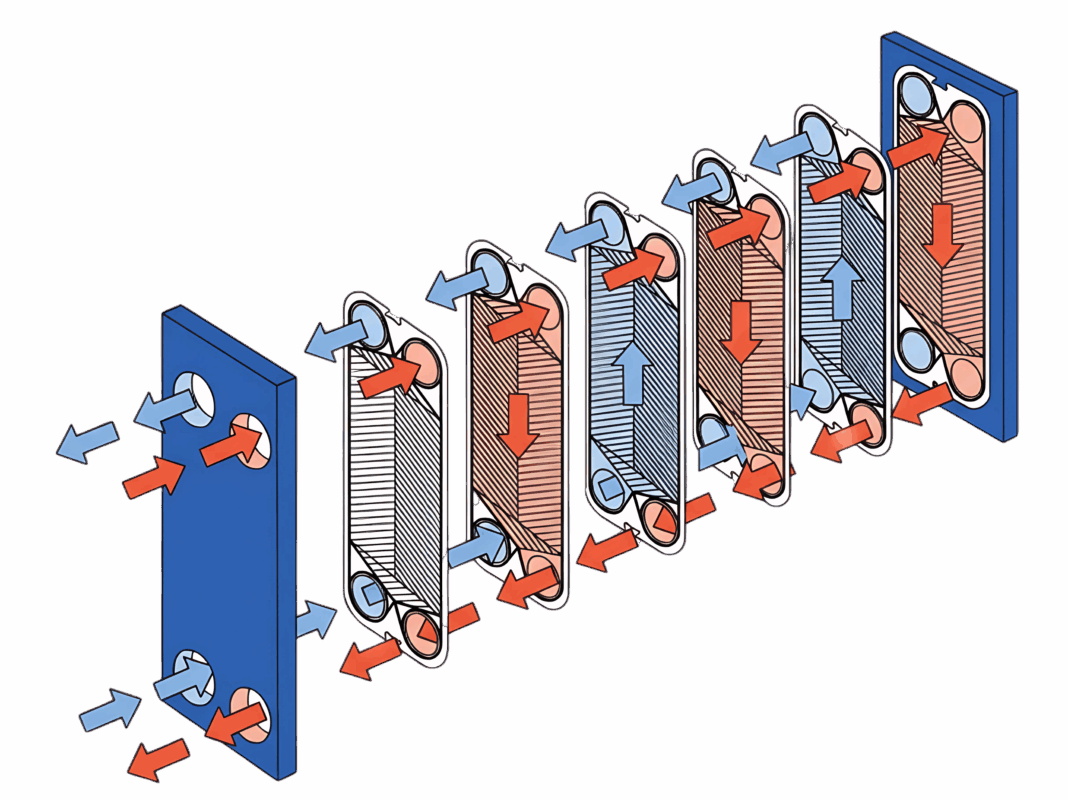
A plate heat exchanger (PHE) is a device that transfers heat from one fluid to another, without the two fluids coming into direct contact. The fluids are kept separate by metal transfer plates that are laid parallel to each other. Think of it as a highly efficient heat-transfer system where fluids exchange thermal energy through an indirect medium - a series of thin metal plates.
A Step-by-Step Guide of How a Plate Heat Exchanger Works
- Fluids Enter the PHE: A hot fluid and cold fluid enter the device through separate inlet ports.
- Fluid Separation: The fluids are directed into alternating channels created by a stack of parallel metal plates. The plates are sealed by gaskets to ensure the fluids never mix.
- Counter-Current Flow: The hot and cold fluids flow in opposite directions, the hot fluid travels down one side of a plate and the cold fluid moves along the opposite side. This opposing flow pattern increases the duration of contact between the fluids, thereby maximising the efficiency of heat transfer.
- Turbulence and Heat Transfer: The surface of the plates is typically corrugated in a herringbone pattern. This texture creates turbulence as the fluids pass over them, which increases the rate of heat transfer and prevents fouling or clogging of the channels.
- Indirect Heat Exchange: Heat from the hot fluid is transferred efficiently across the thin metal plate to the colder fluid.
- Fluids Exit: The now-cooler hot fluid and the now-warmer cold fluid exit the PHE through separate outlet ports.
Key Benefits of a Plate Heat Exchanger
- High Thermal Efficiency: They use a counter-current flow and a large surface area to maximise heat transfer, resulting in lower energy consumption and running costs.
- Compact Design: They transfer a significant amount of heat in a very small footprint, saving valuable plant room space.
- Easy to Maintain: The "plate-and-frame" design allows for simple disassembly, making cleaning and servicing straightforward.
- Versatile: For some PHEs the number of plates can be adjusted, allowing the system's capacity to be easily modified for different heating or cooling needs.
- Durable: They are typically made from robust materials like stainless steel, which provides corrosion resistance and a long service life (fun fact: the Virdis Energy GP Series has been known to last over 30 years!)
Bare PHE vs Packaged PHE
Bare Plate Heat Exchanger (Bare PHE)
A bare plate heat exchanger is the fundamental component of a heat transfer system. It consists of only the essential parts needed for heat exchange: the plates, the gaskets and the frame. It is often chosen for its flexibility and cost-effectiveness.
Key Features:
- Ultimate Customisation: Since it is the core unit it can be integrated into a larger, highly customised system. This is ideal for bespoke projects with a set of specific and unique requirements.
- Expansion & Modification: For demountable models, plates can be added or removed to easily adjust the system’s capacity if a building’s needs change over time.
- Stand Alone Unit: It does not include any of the pumps, valves or controls required to operate as a complete system.
Explore bare plate heat exchanger range.
Packaged Plate Heat Exchanger (Packaged PHE)
A packaged PHE is a complete, pre-assembled solution, often referred to as a "skid-mounted" unit. It includes the bare PHE along with all the necessary ancillary components to operate as a fully functional system.
Key features:
- Fast and Simple Installation: Packaged units are pre-assembled and factory tested which drastically reduces on site labour and minimises disruption to business operations.
- Optimised Efficiency: All components are pre-selected to work together seamlessly, ensuring peak performance and energy efficiency.
- Space-Saving Design: All the necessary equipment is mounted on a single, compact skid, saving significant plant room space compared to assembling individual components separately.
- Single-Source Responsibility: A single point of contact for the entire system, from design to delivery and maintenance, simplifying management.
Explore packaged plate heat exchanger options.
Brazed vs Gasketed: Bare Plate Heat Exchangers
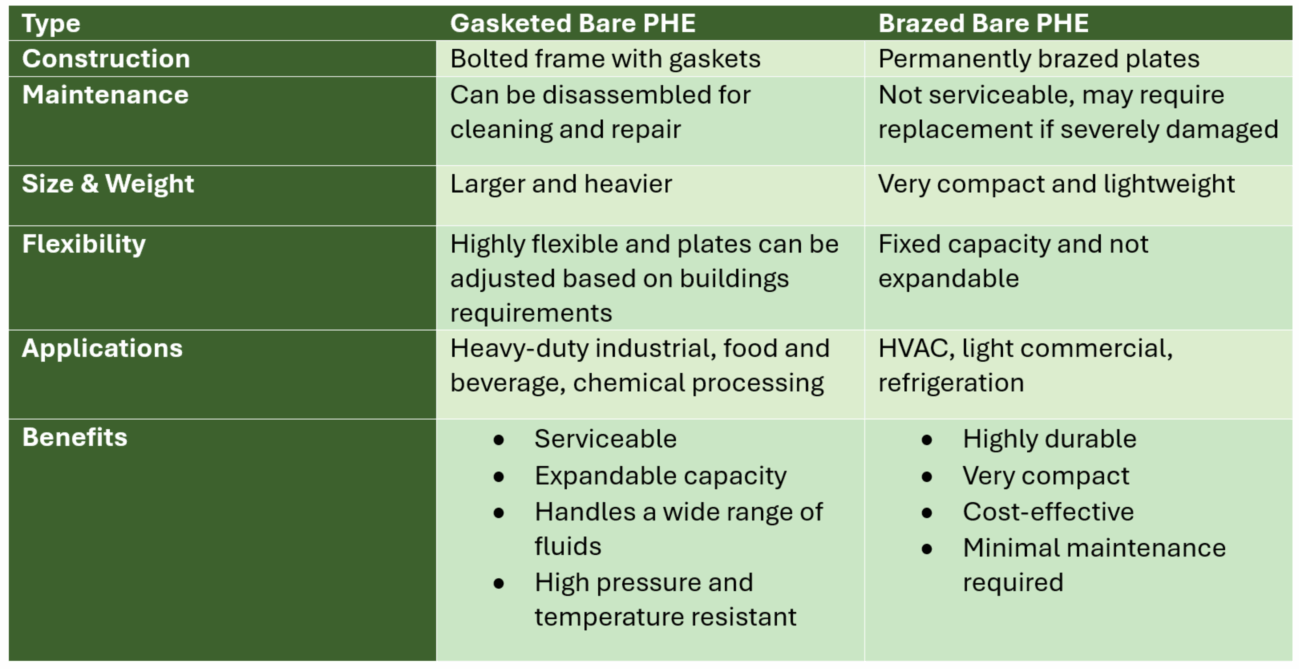
There are two primary types of bare PHEs that you will likely encounter, gasketed and brazed. While both are highly efficient at transferring heat, their construction and applications are quite different. The table below outlines these key distinctions.
Applications of Plate Heat Exchangers
PHEs are widely used across many industries, including:
- Commercial Heating & Hot Water: Hotels, hospitals, offices and residential buildings.
- Industrial Processes: Food and beverage, pharmaceuticals and chemical plants.
- HVAC & Refrigeration: District heating, cooling towers and chilled water systems.
- Renewables & Energy Systems: Heat recovery, biomass and combined heat and power (CHP) plants.
Conclusion
Choosing between a Bare or Packaged Plate Heat Exchanger depends on the unique requirements of your building or project. Bare PHEs offer maximum flexibility and integration potential, while packaged units provide a ready-to-install, fully optimised solution.
At Virdis Energy, we offer a comprehensive range of both Bare and Packaged PHEs, designed for longevity, efficiency and reliability.
Contact our technical team today to find the best heat exchanger solution for your project.